
 By Sandeep Saxena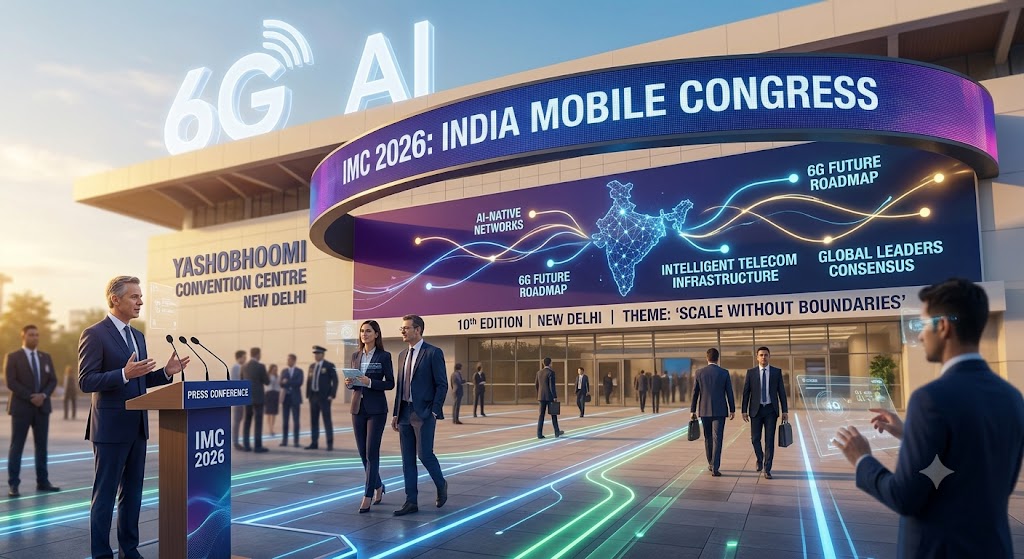
AI-Native Networks and 6G at IMC 2026: At the milestone 10th edition of the India Mobile Congress (IMC) 2026, convened at the Yashobhoomi Convention Centre in New Delhi under the theme “Scale Without Boundaries,” global telecom leaders, standards organizations, and policymakers delivered an unequivocal consensus. The collective direction for telecommunications is no longer confined to expanding baseline user connectivity. Instead, the strategic priority has decisively pivoted toward embedding autonomous intelligence directly into network architectures, establishing unified international standards for 6G, and scaling indigenous intellectual property globally.
The overarching dialogue around AI-Native Networks and 6G at IMC 2026 reflected a fundamental industry realization: raw network bandwidth alone is insufficient. As intelligent agentic workflows and automated edge systems multiply, telecom pipelines must evolve into self-optimizing, context-aware digital fabrics.
1. The Transition to 5G Standalone and Intelligent Fabrics
Industry infrastructure leaders emphasized that monetization and future network readiness depend on migrating fully to programmable 5G Standalone (SA) cores.
-
Ericsson’s Perspective on 5G SA: Andres Vicente, CEO for South-East Asia, Oceania, and India at Ericsson, noted that India’s rapid deployment makes it an innovation engine for global network architectures. He stressed that transitioning to 5G Standalone enables the programmable capabilities necessary to deliver differentiated connectivity and host AI workloads.
-
The Concept of ‘Intelligent Fabric’: Erik Ekudden, Group CTO at Ericsson, highlighted that as artificial intelligence transitions into physical automation and industrial enterprise tasks, networks must function as an integrated fabric merging high-capacity connectivity, distributed cloud nodes, and edge computing to sustain sub-millisecond latencies.
-
GSMA’s Vision on Network Intelligence: Vivek Badrinath, Director General of GSMA, underscored that with more than a billion users connected in India, the core question is what those users and enterprises build with that infrastructure. Networks must become programmable conduits capable of powering an AI-first digital economy.
2. On-Device Compute vs. Cloud Infrastructure Economics
A critical insight on edge processing versus cloud scaling was outlined by Qualcomm during the keynote presentations:
-
Shifting Workloads to the Edge: Etienne Chaponniere, ISAG Chair at Qualcomm, explained that as smartphones, autonomous vehicles, and IoT sensors gain contextual awareness, streaming raw high-definition telemetry back to centralized clouds would overwhelm global bandwidth and power grids.
-
Economic Realities of Compute: Processing intelligence directly on edge silicon shifts the compute cost away from centralized cloud operators onto local device hardware. This dynamic necessitates designing future network interfaces to accommodate pre-processed, filtered data streams rather than raw, uncompressed packets.
-
Hardware-Scale Equation: Giacomo Robustelli of TIM emphasized that artificial intelligence is as much an infrastructure disruption as a software revolution. If underlying physical data centers, optical fiber links, and security perimeters fail to scale proportionally, AI adoption reaches a bottleneck.
3. 6G Standardization: Moving Beyond Raw Speed
The strategic blueprint surrounding AI-Native Networks and 6G at IMC 2026 made it clear that 6G will not merely be an incremental speed boost over 5G:
-
Bharat 6G Alliance Roadmap: N. G. Subramaniam, Chairman of the Bharat 6G Alliance, noted that India’s 6G mission is progressing in mission mode with deep public-private collaboration. He stated that in the 6G era, knowledge and situational insights will be consumed intuitively, interactively, and instantaneously.
-
Global 3GPP Harmonization: Dr. Youn Sun Kim, 3GPP RAN Chair from Samsung Korea, highlighted the need for unified international frameworks that bridge diverse regional operator requirements, harmonize terrestrial and satellite networks, and optimize sustainable spectral efficiency.
-
Reliance Jio on Compute-Connectivity Convergence: Shyam Prabhakar Mardikar, Group CTO (Mobility) at Reliance Jio, stated that 6G will redefine telcos into intelligent platforms that link societal and enterprise actions directly with personalized, real-time insights.
4. Automation, Quality of Experience (QoE), and Domestic IP Creation
Domestic operators and research leaders addressed operational sustainability and value capture:
-
Zero-Touch Automation: U.K. Srivastava of Reliance Jio highlighted that zero-touch networks and predictive maintenance are paramount in high-density markets like India, where brief disruptions affect millions of digital transactions.
-
Focusing on Quality of Experience (QoE): Nirmesh Yadav from Bharti Airtel pointed out that 5G monetization hinges on end-user experience metrics—such as uninterrupted enterprise video calls—rather than peak synthetic speed tests.
-
Indigenous Design and Intellectual Property: Dr. Rajkumar Upadhyay, CEO of C-DOT, emphasized that India’s telecom growth must move beyond assembly and manufacturing toward domestic design, intellectual property (IP), and sovereign cybersecurity standards.
Conclusion: The Strategic Road Ahead
The deliberations on AI-Native Networks and 6G at IMC 2026 mark a decisive maturation of the telecommunications industry. As edge devices become smarter and enterprise automation expands, the network itself is evolving from a passive data pipe into an active, intelligent operating system.
Related Reading:
Explore our recent analysis on how homegrown hardware is driving connectivity in our feature on the Sensorise Wega M1 GSM Module Launch at IMC 2026.
For continuous telecommunications analysis, enterprise tech breakdowns, and next-generation mobility reports, follow GadgetXprt.com.