
 By Sandeep Saxena
Artificial intelligence has become the primary buzzword across the smartphone industry. From real-time voice translation and context-aware summaries to generative object removal in photos, manufacturers are aggressively marketing “AI-powered” flagships and mid-range devices.
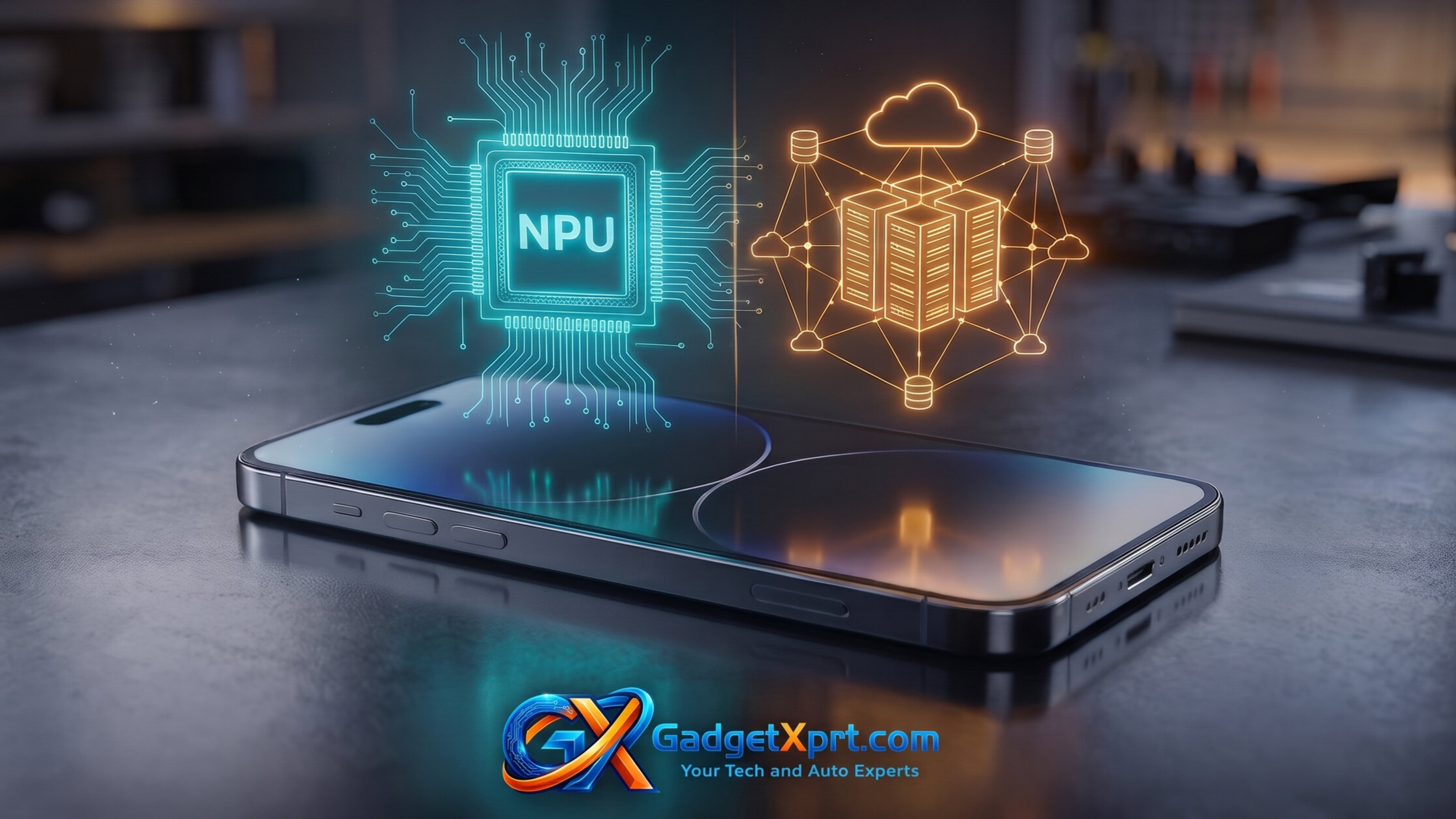
However, there is a fundamental distinction that marketing brochures rarely highlight clearly: not all mobile AI works the same way. Understanding the technical divide between On-Device AI vs Cloud AI—and checking the NPU (Neural Processing Unit) capabilities—is critical for data privacy, execution speed, and real-world battery efficiency.
Some artificial intelligence computations run locally on the silicon inside your pocket, while others beam your sensitive data to remote server farms for cloud processing. Before purchasing your next device, understanding the technical boundary between on-device and cloud processing is essential.
1. On-Device AI vs Cloud AI: Understanding Edge Silicon vs. Remote Servers
When you trigger an artificial intelligence task on your smartphone, the operating system routes the request through one of two technical pathways:
On-Device (Edge) AI
In this workflow, the computational load is handled entirely by your handset’s dedicated NPU, alongside the CPU and GPU. Smaller, highly optimized Large Language Models (LLMs) and neural networks are compressed to sit directly in your phone’s flash storage and RAM.
-
Latency: Near-zero lag, as requests do not travel over cellular network towers.
-
Offline Functionality: Voice-to-text transcription, local app predictions, and offline translation work seamlessly without an active mobile data connection or Wi-Fi.
-
Privacy: Sensitive inputs—such as voice recordings, private notes, and camera feeds—never leave the sandboxed storage on the device.
Cloud-Based AI
Heavier computational workloads rely on vast hyperscale server farms. Your handset acts simply as a terminal: it captures your prompt, photo, or audio file, transmits it via cellular or Wi-Fi networks to a remote cloud data center, waits for the massive models to compute the result, and downloads the output back to your screen.
-
Processing Depth: Capable of complex, high-parameter generative art and deep text analysis that mobile silicon cannot fit into local RAM.
-
Network Dependence: If you lose connectivity or hit a slow cellular zone, the feature stalls or fails completely.
-
Privacy Trade-offs: Your data leaves your local sandbox and enters third-party processing queues and server logs.
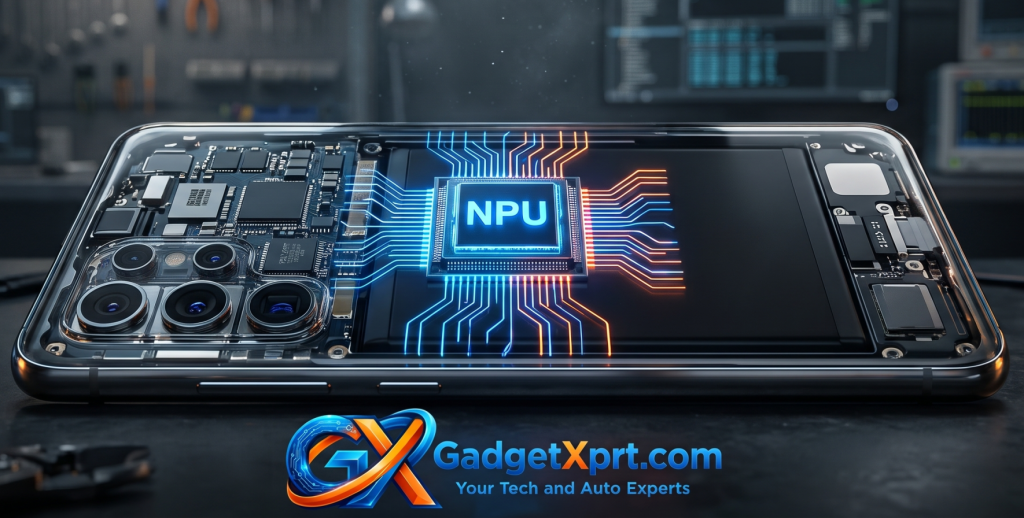
2. Why the NPU (Neural Processing Unit) Is the New Mega-Spec
In previous years, mobile buying decisions revolved around CPU clock speeds and GPU core counts. Today, the Neural Processing Unit is the single most decisive hardware block determining how well a smartphone executes modern machine learning workloads.
CPUs handle general sequential instructions, while GPUs excel at massive parallel rendering for 3D gaming. However, running neural networks requires continuous matrix multiplication at extremely low power draw. NPUs are specialized hardware blocks architected specifically for integer math (such as INT8 and INT4 precision) and low-precision floating-point operations.
NPU computing throughput is measured in TOPS (Trillions of Operations Per Second). Flagship processors pack NPUs capable of exceeding 40 to 50 TOPS, allowing them to run 7-billion to 10-billion parameter models locally without turning the chassis into a hand-warmer.
Before buying, reviewing verified chip architectural whitepapers—such as the Qualcomm Neural Processing SDK documentation or official technical specifications via MediaTek Dimensity developer guides—ensures the silicon on your chosen model supports hardware-accelerated local execution rather than forcing the device to lean entirely on cloud fallbacks.
3. On-Device AI vs Cloud AI: Head-to-Head Comparison
To understand the core functional trade-offs between local processing and cloud reliance, examine the structured breakdown below:
| Feature Parameter | On-Device (Local) AI | Cloud-Based AI |
| Data Privacy | High (All data stays in local sandboxed storage) | Lower (Prompts and media upload to external servers) |
| Internet Dependency | 100% Offline Capable | Requires constant, low-latency broadband/5G |
| Response Latency | Instantaneous (Milliseconds) | Variable (Depends on network ping & server queues) |
| Hardware Requirement | High (Demands powerful NPU & minimum 12GB+ RAM) | Low (Runs on budget chips via web/API routing) |
| Subscription Risk | Usually free for the lifetime of the hardware | May convert into paid monthly SaaS subscriptions |
| Battery Impact | Higher burst drain on mobile silicon | Low local silicon drain, higher cellular radio power draw |
4. Three Critical Factors to Evaluate Before You Upgrade
When analyzing new smartphone specifications, look beyond generic marketing banners and verify these three architectural factors:
1. Unified RAM and Model Memory Footprint
Local generative models require significant memory bandwidth. When an on-device model loads into memory, it consumes anywhere from 2GB to 4GB of RAM exclusively for weights and context caching. If you buy a smartphone with only 6GB or 8GB of total RAM, system multitasking suffers, forcing the OS to offload features to the cloud. For seamless local execution, look for devices offering at least 12GB of high-speed LPDDR5X memory.
2. The Subscription Trap on Cloud Features
Cloud server farms cost billions to build and maintain. Several major smartphone brands have introduced disclaimers in their software terms indicating that advanced cloud-powered photo editing and generative writing features may require paid subscriptions in future firmware cycles. Conversely, features powered purely by local on-device NPUs remain free because your own silicon does the heavy lifting.
3. Thermal Throttling During Sustained AI Workloads
Running continuous generative tasks locally—such as generating multiple AI images or transcribing hour-long audio recordings—puts sustained thermal pressure on the mobile SoC. Premium smartphones equipped with vapor chamber cooling sustain NPU burst performance much better than entry-level chassis that quickly overheat and throttle processing speeds.
The Verdict on On-Device AI vs Cloud AI
Artificial intelligence is an exciting evolution in mobile technology, but do not be swayed by flashy presentation slides alone. In the debate between On-Device AI vs Cloud AI, your priority should depend on how much you value long-term data privacy, zero-latency feedback, and reliable offline functionality.
When evaluating a new smartphone, check whether its marquee features work offline in airplane mode. Choosing a phone with a robust NPU and ample unified RAM guarantees that your private data stays on your device, your features remain subscription-free, and your daily experience stays fast and responsive regardless of network connectivity.
For technical smartphone teardowns, silicon architecture evaluations, and mobile AI benchmark updates, follow GadgetXprt.com.