
 By Sandeep Saxena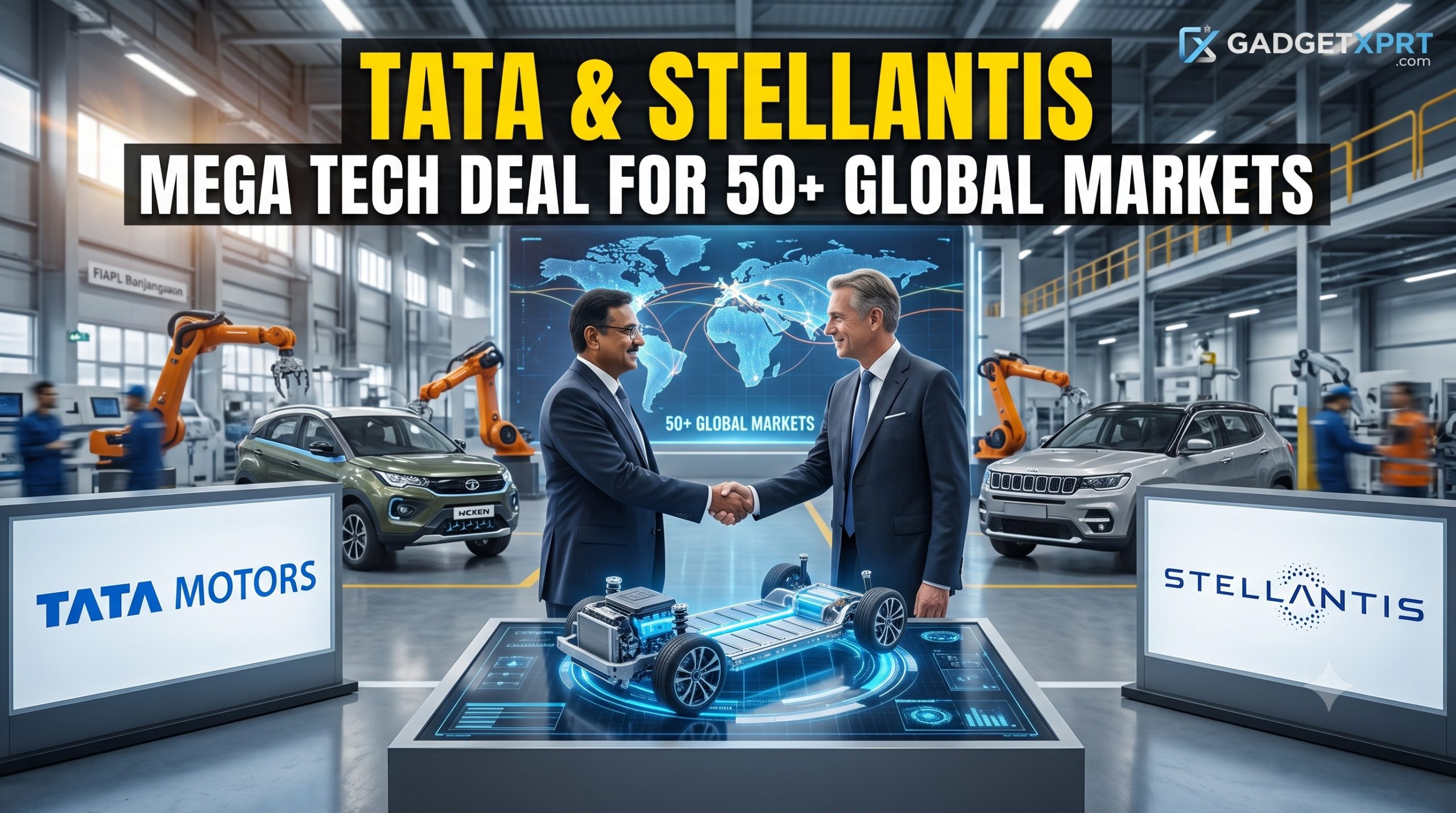
In a defining development that cements India’s arrival as a global engineering nerve center, Tata Motors Passenger Vehicles Limited (TMPV), its dedicated EV subsidiary Tata Passenger Electric Mobility Limited (TPEM), and multinational automotive conglomerate Stellantis India have formally signed a Definitive Agreement.
The Tata Motors Stellantis partnership expands their two-decade-long joint manufacturing relationship into a comprehensive technology-sharing and platform-export alliance. Under this landmark framework, Stellantis will gain direct access to Tata Motors’ indigenous vehicle architectures, powertrain technologies, and electric mobility engineering, adapting them for distribution across more than 50 global markets.
Strategic Shift: From Shared Manufacturing to Platform Adoption
The collaboration transitions an initial Memorandum of Understanding (MoU) signed in February 2026 into a legally binding execution roadmap. Rather than a standard automotive contract assembly deal, the pact represents an inverted technological flow: one of the world’s largest automotive groups is actively adopting Indian vehicle architectures to power international models.
-
Direct Architectural Access: Stellantis will leverage TMPV’s core passenger vehicle platforms, integrating its own exterior body styling, software suites, and brand DNA.
-
Engineering Adaptation for 50+ Export Destinations: Stellantis engineering centers will tune these vehicle platforms to meet stringent safety, regulatory, crash-test, and emission standards across international markets in Europe, South America, Asia-Pacific, and Africa.
-
Shared Industrial Muscle: The vehicles will roll off production lines at Fiat India Automobiles Private Limited (FIAPL) in Ranjangaon, Pune—the established 50:50 joint venture facility between both automotive groups.
Key Pillars of the Tata-Stellantis Strategic Framework
The table below outlines the core dimensions and strategic architecture defining the new Tata Motors Stellantis partnership:
| Alliance Dimension | Key Strategic Detail |
| Partner Entities |
TMPV, TPEM (Tata EV Arm), and Stellantis India |
| Agreement Type |
Definitive Agreement (Formal Execution of Feb 2026 MoU) |
| Technology Flow |
Tata shares vehicle architectures & modern EV/ICE powertrain tech |
| Target Export Footprint |
Over 50 international automotive markets |
| Production Hub |
FIAPL Facility, Ranjangaon (Pune, Maharashtra) |
| Joint Venture Ownership |
50:50 Manufacturing Equity Split |
| Stellantis Global Brand Network |
14 Brands (Jeep, Citroën, Peugeot, Fiat, Alfa Romeo, etc.) |
| Current FIAPL Production |
Tata Nexon, Curvv, Altroz; Jeep Compass, Meridian |
Manufacturing Synergies at FIAPL Ranjangaon
The FIAPL manufacturing complex in Ranjangaon already serves as a benchmark for high-precision automotive assembly in India. Spanning vehicle assembly lines, transmission machining, and traction motor manufacturing, the facility currently produces domestic bestsellers like the Tata Nexon, Curvv, and Altroz alongside premium global utility vehicles like the Jeep Compass and Meridian.
Through shared assembly lines in Pune, the Tata Motors Stellantis partnership enables deep supply chain localization while meeting global regulatory requirements.
By integrating Tata’s flexible modular architectures directly onto FIAPL’s shared assembly lines, the Tata Motors Stellantis partnership unlocks massive economies of scale. High localized component sourcing keeps manufacturing costs globally competitive while positioning the Ranjangaon plant as an export springboard for right-hand-drive and left-hand-drive markets worldwide.
Leadership Perspectives on the Milestone Alliance
Both automotive groups have emphasized that the Tata Motors Stellantis partnership is designed to scale local production while accelerating international exports.
Speaking on the signing of the definitive agreement, Mr. Shailesh Chandra, Managing Director & CEO, Tata Motors Passenger Vehicles and TPEM, stated:
“Our partnership with Stellantis has grown steadily over more than two decades, built on mutual trust and complementary strengths. This Agreement marks an important next step, extending our relationship into advanced vehicle technology and architecture, reflecting the strength and competitiveness of TMPV’s capabilities in these areas. We are delighted that Stellantis will leverage them to develop products for global markets. Together, we have an exciting opportunity to combine our respective strengths to create compelling vehicles engineered and made in India for customers in India and around the world.”
Reinforcing the global export perspective, Mr. Tianshu Xin, Chief Operating Officer, Stellantis Asia-Pacific Region, added:
“Partnerships are central to how Stellantis creates value across Asia-Pacific. By combining Tata Motors’ strong capabilities in India with Stellantis’ global product development and market reach, this Agreement will help us develop competitive vehicles in India and expand our export potential across international markets. It also reinforces India’s growing role as a strategic manufacturing and development hub for Stellantis.”
Editorial Take: Why This Agreement Alters Global Auto Dynamics
The automotive industry has historically seen Western and East Asian automakers license legacy architectures to Indian manufacturers. The Tata Motors Stellantis partnership decisively breaks that paradigm.
With Tata Motors commanding dominant passenger EV market share in India through Gen-2 and Gen-3 skateboard development, Stellantis can deploy proven, cost-optimized vehicle platforms without incurring duplicative multi-billion-dollar R&D outlays. For Indian automotive manufacturing, the agreement validates indigenous engineering at a truly global tier.
For corporate updates and platform roadmaps, visit the official Tata Motors Portal.
For continuous automotive industry analysis, electric mobility breakthroughs, and global vehicle platform teardowns, follow GadgetXprt.com.